Events and actions
Making a widget do something - and reaching your own code when the built-in actions run out.
An event is a trigger on a widget and a list of actions to run when it fires. Both come from
the SquareLine Studio model, so if you have used that, this is the same thing with a few
additions: swipe triggers on every widget, and hardware actions that reach the data layer. The
generator writes one ui_event_<Name>() handler per widget that has events,
registers it with lv_obj_add_event_cb(), and dispatches on the event code inside.
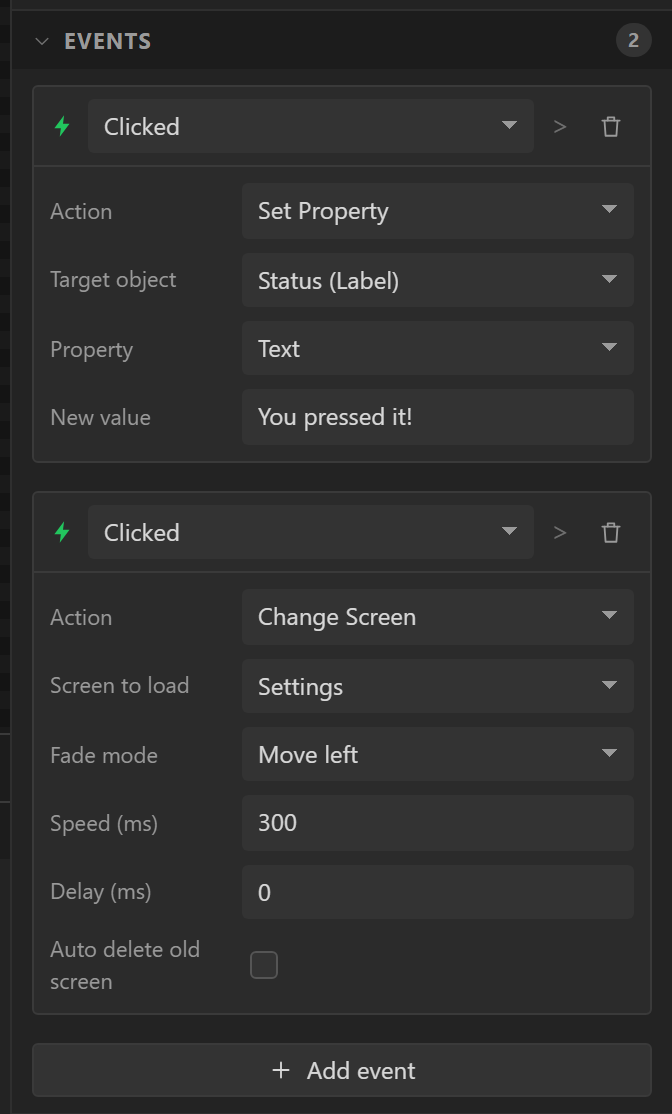
Adding one
Select the widget, scroll the Inspector to Events, click add, pick the trigger, then add actions to it. Each action has its own fields - a Change Screen needs a screen, an Increment Slider needs a target and an amount. An action with an empty required field is reported by the validator as an error, since the generator cannot emit it.
Triggers
| Trigger | Fires when |
|---|---|
| Pressed | The finger goes down. |
| Clicked | Pressed briefly then released, without scrolling. The one to use for buttons. |
| Short clicked | A brief tap. |
| Long pressed | Held past the long-press time. |
| Long pressed repeat | Repeatedly while still held after a long press - for auto-repeat. |
| Released | The finger lifts, click or not. |
| Focused / Defocused | Keyboard or encoder focus moves onto or off the widget. |
| Value changed | A slider, arc, switch, checkbox, dropdown, roller, spinbox or textarea changed. |
| Ready / Cancel | A process finished or was abandoned - the keyboard's tick and cross. |
| Checked / Unchecked | A checkable object toggled. |
| Gesture (any) | A swipe in any direction. |
| Swipe up / down / left / right | A swipe in that direction. |
| Key | A key was sent to the widget from a keypad or encoder. |
| Edited / Insert | Text changed or text was inserted in a textarea. |
| Screen loaded / unloaded, Screen load start / unload start | Screens only. |
The four Screen triggers are only offered on a screen, and are the place for anything that should happen as a page appears - refreshing a readout, starting an animation. Screen loaded fires after the load animation; Screen load start before it.
Actions
| Action | Fields | Does |
|---|---|---|
| Call function | Function name | Calls a function you write in ui_events.c. |
| Change Screen | Screen, fade mode, speed, delay, auto delete | Loads another screen with an animation. |
| Delete screen | Screen | Frees a screen from RAM. |
| Increment Arc / Bar / Slider | Target, value (and animation time) | Adds a signed amount to the target's value. |
| Step spinbox | Target, direction | Increments or decrements the spinbox by its step. |
| Modify Flag | Target, flag, Add / Remove / Toggle | Changes an object flag - toggling Hidden is the usual case. |
| Set Flag | Target, flag, on/off | Sets a flag to a known state. |
| Set Opacity | Target, opacity | Sets the target's main-part opacity. |
| Set Property | Target, property, value | Sets Text, Value, Value (animated), Image source, Range min or max, Selected index, Background colour or Text colour. |
| Play Animation | Target, property, start, end, duration, delay, path, repeat count, playback | Animates X, Y, width, height, opacity, scale or rotation with an easing path. |
| Set text value from arc / slider | Target label, source, prefix, postfix | Writes the source's value into a label as text. |
| Set text value when checked | Target label, source, checked text, unchecked text | Writes one of two strings depending on a checkbox or switch. |
| Switch Theme | Light / Dark | Re-initialises the theme at runtime. |
| Set variable | Variable, mode, value | Writes a data-layer variable. See below. |
| Set digital output | Output, Activate / Deactivate / Toggle | Drives a digital output, on an MCU pin or an extender. |
| Write to peripheral | Peripheral, channel, value | Writes to a writable channel such as a PCA9685 output. |
| Refresh inputs now | - | Reads every peripheral, analog and digital input immediately. |
Change Screen, in detail
The most used action. Besides the target screen it takes a fade mode - None, Over
left/right/top/bottom, Move left/right/top/bottom, Fade in, Fade out, Out left/right/top/bottom
- a speed in milliseconds, a delay, and auto delete, which frees the
screen being left. It becomes _ui_screen_change() in ui_helpers.c, which
creates the target if it has been freed and calls lv_screen_load_anim(). The preview
runs it too, switching the canvas to the target screen.
Call function
The escape hatch. Give it a function name and the generator declares it in
ui_events.h and writes a stub in ui_events.c:
void my_callback(lv_event_t * e)
{
    // TODO: your code here
}
ui_events.c is the one generated file that is yours: the stubs are regenerated
on every export but a file you have edited is never overwritten, so your code survives. Inside a
callback you have the whole LVGL API and every ui_<Name> object from
ui.h.
Hardware actions
The last four actions belong to the data layer and are the bridge from a touch to the firmware's state. Set variable writes a variable - a fixed value, a formula, an amount added, a toggle for a Boolean, or the value of a widget - and every binding that reads it updates on the next refresh. Set digital output drives an output on an MCU pin or an I/O extender. Write to peripheral pushes a value to a writable channel (a PCA9685 PWM channel, a NeoPixel colour). Refresh inputs now forces an immediate read of everything rather than waiting for the poll interval. The same four are available to automations.
In the preview
Events run in preview: a Clicked button changes screen, toggles a flag, steps a value, sets a variable. Since a mouse cannot swipe, a pad at the bottom of the canvas sends the four gestures and shows whether anything on the screen listens for each. Play Animation, Switch Theme and peripheral writes cannot be simulated and say so in the Console tab rather than silently doing nothing.
Event bubbling
A tap on a label inside a panel is a tap on the label, not the panel. Set the label's Event bubble flag and the panel's handler sees it as well; set Gesture bubble for swipes to travel the same way. A screen's swipe triggers rely on this: a swipe that starts on a widget without Gesture bubble stops there.