Waveshare ESP32-S3-Touch-LCD-3.49
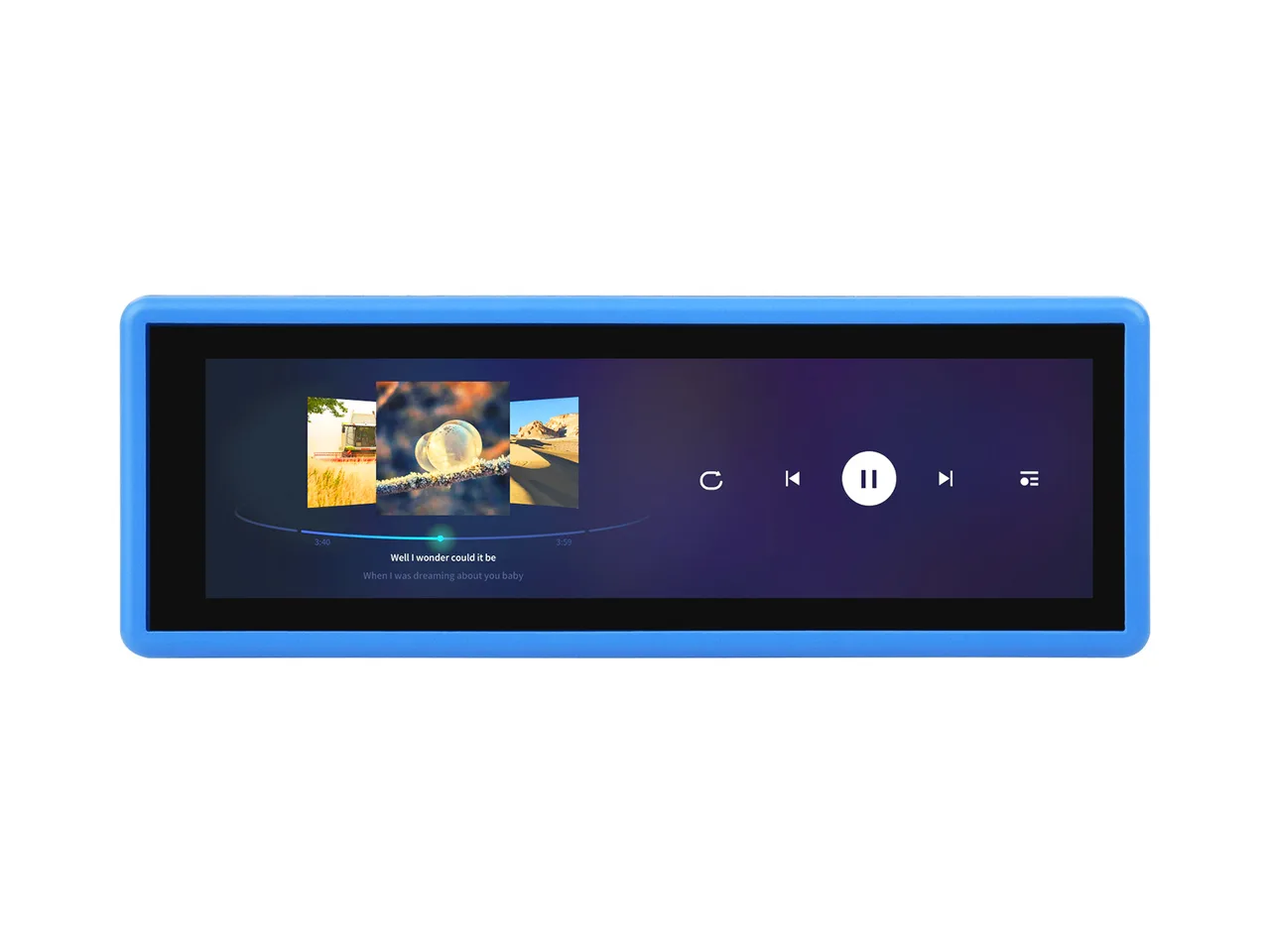
3.49" 172x640 IPS LCD (AXS15231B, QSPI), AXS15231B (integrated touch) touch, ES8311 speaker and ES7210 microphones, TF card, QMI8658, PCF85063, battery sense.
Affiliate link: LCD Wizard may earn a commission if you buy through it.
Building for it
A project is made for one toolchain, picked when you start it. All four can drive this board:
| Toolchain | |
|---|---|
| Arduino (C++) | Every board, every widget and every peripheral here. The most control, and the most to set up. Start a project |
| MicroPython | Change a screen by editing a file on the board. No compiler once it is flashed. Start a project |
| ESPHome | No compiler to install, and the panel can join Home Assistant as real entities. Start a project |
| ESP-IDF (C) | Espressif's own framework: esp_lcd, the component registry and idf.py, with nothing of Arduino in it. Start a project |
At a glance
| Part | Detail |
|---|---|
| Maker | Waveshare |
| MCU | ESP32-S3 Xtensa LX7 dual-core @ 240 MHz, 512 KB SRAM (+ 2-16 MB PSRAM on most modules) |
| Display | Astra AXS15231B, 172 x 640 px, QSPI (quad SPI), 16-bit colour |
| Touch | Astra AXS15231B (touch half) (capacitive, I2C) |
| Backlight | GPIO 42, dimmable (PWM) |
| Memory | 16 MB flash, 8 MB octal PSRAM (N16R8) |
| Graphics library | GFX Library for Arduino |
Display pins
AXS15231B on QSPI (quad SPI): QSPI clock 40 MHz, host SPI3_HOST, RGB colour order, inversion off.
| Signal | Pin |
|---|---|
| SCK | GPIO 10 |
| D0 - D3 | GPIO 11, 12, 13, 14 |
| CS | GPIO 9 |
| RESET | TCA9554 pin 5 |
| Backlight | GPIO 42 (active low) |
Touch pins
AXS15231B (touch half): I2C address 0x3B, 400 kHz, X and Y swapped, Y inverted.
| Signal | Pin |
|---|---|
| SDA | GPIO 17 |
| SCL | GPIO 18 |
| INT / IRQ | TCA9554 pin 0 |
| RESET | not connected |
Also on the board
- I2C (GPIO 47 / 48) - SDA GPIO 47, SCL GPIO 48
- TCA9554 I/O expander at 0x20, driving the lines marked above
- IMU - QMI8658, at 0x6B, on I2C (GPIO 47 / 48)
- RTC - PCF85063, at 0x51, on I2C (GPIO 47 / 48)
- SDCard - SD card, CLK GPIO 41, CMD GPIO 39, D0 GPIO 40
- TCA9554 pin 1 is set high at boot - Backlight boost enable (EXIO1)
- TCA9554 pin 6 is set high at boot - Battery power hold (EXIO6)
- Battery - analog input on GPIO 4
- BOOTButton - input on GPIO 0
- PWRSYSOUTButton - input on GPIO 16
The preset adds these to the Hardware tab with the board, so a sensor can go straight onto the connector.
Check your revision. Pins from Waveshare's demo code and schematic (https://github.com/waveshareteam/ESP32-S3-Touch-LCD-3.49-V2). Two hardware revisions with different pins; recorded V2 (Rev1.1 silkscreen), which is all that ships since 2026-06-08. The touch panel has I2C pins 17/18 to itself; the I/O expander, both audio chips, the IMU and the clock are on 47/48. The backlight needs EXIO1 on the expander held high as well as its PWM pin (active low), and the panel is reset through EXIO5. The ES7210 is at its default address 0x40, not re-read from its straps, with its data on GPIO 6. Battery sense is GPIO4 through a divide-by-three; the scale is not calibrated. The PWR key's active level is not verified. The touch panel reports along the long side of the glass: x is its Y, and y is 640 less its X (Waveshare's lvgl_port.c), which is Swap X/Y with Invert Y here - seen wrong on the owner's board on 2026-10-10 before this was set. Run on a V2 board on 2026-10-10: the panel, the touch, the backlight and the parts above were reported working with this preset.
Designing for it in LCD Wizard
- Choose Waveshare ESP32-S3-Touch-LCD-3.49 on the Hardware tab (or use the button above) and every pin on this page is filled in. The export writes the sketch,
lcd_pins.h, the GFX Library for Arduino configuration,lv_conf.handplatformio.ini- a project that builds for this board as it comes. - The AXS15231B (touch half) is capacitive and needs no calibration. The firmware resets it and checks it answers on every boot.
- The backlight is dimmable: give a slider or a button a Set backlight action.
- With PSRAM the LVGL memory pool can live there, leaving internal RAM for everything else.
- Screens are designed for 172 x 640 px in either orientation, with LVGL 9 or LVGL 8.
The parts
AXS15231B. Combined display + capacitive touch controller. Touch shares the same part. Drawn a whole frame at a time, so it needs PSRAM.
AXS15231B (touch half). The same silicon as the AXS15231B display controller; touch is read over I2C.
ESP32-S3. The only common Arduino target with a hardware RGB565 LCD peripheral. PSRAM is effectively required for RGB panels.
GFX Library for Arduino. Moshi Liu's library. Best QSPI/AMOLED and RGB coverage. Configured in code.
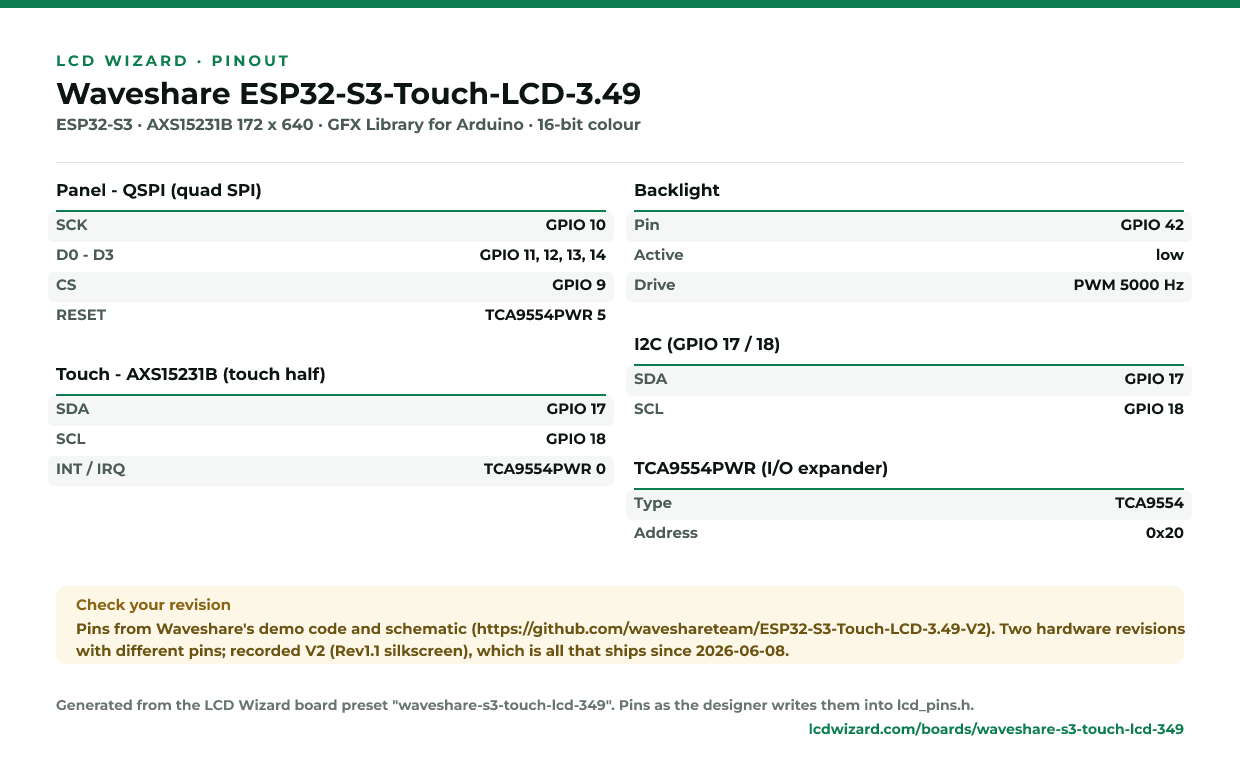
The pinout on one page
Every pin above, laid out to print and keep beside the bench. Generated from this preset, so it says exactly what the designer writes into lcd_pins.h.
Download the pinout (PNG)Open it as SVG
The same pins as data - board.json and pins.csv - are in the open pinout dataset on GitHub, free to reuse under CC BY 4.0.
From the people who made it
The board’s own documentation. Pinouts on vendor pages do sometimes disagree with the hardware in front of you - where this page and that one differ, trust your board and tell us.
- The vendor’s product page
- Vendor documentation
- Schematic (PDF)
- Waveshare demo code (pins read from here)
Designs for this board
Clone any of them into the designer, or see every design for this board in the gallery.
From the blog
Similar boards
 Waveshare ESP32-S3-Touch-LCD-3.5B3.5" 320x480 AXS15231B over QSPI with touch in the same chip, an ES8311 codec with a microphone and speaker output, IMU, RTC, battery charging, a TF card and a camera connector.ESP32-S3 · AXS15231B 320 x 480 · AXS15231B (touch half) touchPurchase this board
 Waveshare ESP32-S3-Touch-LCD-1.85C1.85" 360x360 IPS LCD (ST77916, QSPI), CST816 (CST816S datasheet linked by vendor) touch, ES8311 (V2); PCM5101APWR on V1 audio, TF card, PCF85063ATL.ESP32-S3 · ST77916 360 x 360 · CST816S touchPurchase this board
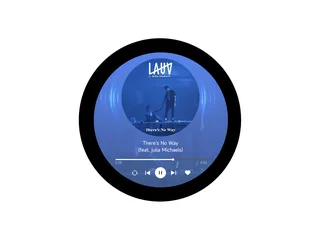 Waveshare ESP32-S3-Touch-LCD-1.851.85" 360x360 IPS LCD (ST77916, QSPI), CST816 (CST816S/T family) touch, PCM5101A (I2S DAC, no control bus) audio, TF card, QMI8658C, PCF85063A.ESP32-S3 · ST77916 360 x 360 · CST816S touchPurchase this board
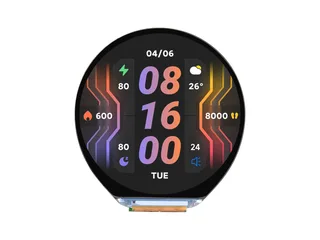 Waveshare ESP32-S3-Touch-LCD-1.46B / 1.46C1.46" round 412x412 IPS LCD (SPD2010, QSPI), SPD2010 (integrated touch) touch, PCM5101 speaker and I2S microphone, TF card, QMI8658, PCF85063, battery sense. The 1.46B and 1.46C are the same board; the C has a wider cover glass.ESP32-S3 · SPD2010 412 x 412 · SPD2010 (touch half) touchPurchase this board
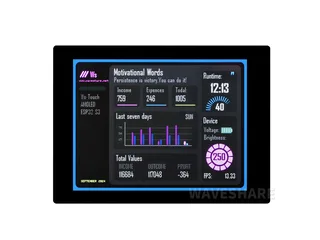 Waveshare ESP32-S3-Touch-AMOLED-2.41 V22.41" 450x600 AMOLED (RM690B0, QSPI), FT6336 touch, TF card, QMI8658, PCF85063, battery sense.ESP32-S3 · RM690B0 450 x 600 · FT6236 / FT6336U touchPurchase this board
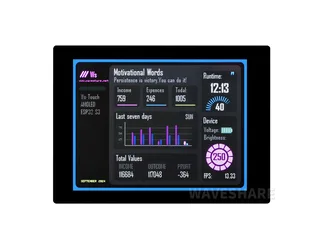 Waveshare ESP32-S3-Touch-AMOLED-2.41 V12.41" 450x600 AMOLED (RM690B0, QSPI), FT6336 touch, TF card, QMI8658, PCF85063, battery sense.ESP32-S3 · RM690B0 450 x 600 · FT6236 / FT6336U touchPurchase this board
Next
- Quick start - from an empty screen to firmware on the board
- Boards and displays - presets, controllers, pins and touch in the designer
- Flashing and configuration - PlatformIO, the Arduino IDE and first-boot checks
- Troubleshooting - a white screen, mirrored image or touch that misses