Guition ESP32-4848S040, speaker version (4" 480x480)
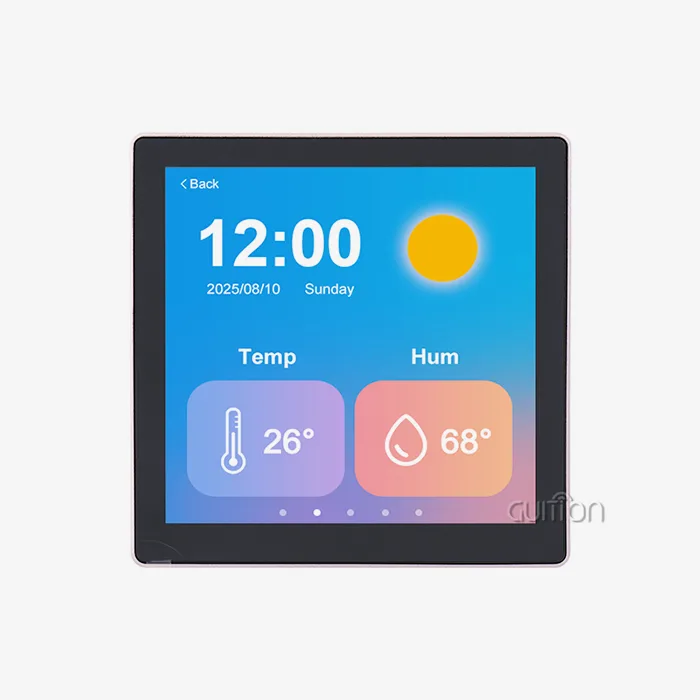
4" 480x480 square ST7701 panel with GT911 touch and an NS4168 I2S speaker amplifier, the "86 box" wall-plate unit.
Building for it
A project is made for one toolchain, picked when you start it. All four can drive this board:
| Toolchain | |
|---|---|
| Arduino (C++) | Every board, every widget and every peripheral here. The most control, and the most to set up. Start a project |
| MicroPython | Change a screen by editing a file on the board. No compiler once it is flashed. Start a project |
| ESPHome | No compiler to install, and the panel can join Home Assistant as real entities. Start a project |
| ESP-IDF (C) | Espressif's own framework: esp_lcd, the component registry and idf.py, with nothing of Arduino in it. Start a project |
At a glance
| Part | Detail |
|---|---|
| Maker | Guition |
| MCU | ESP32-S3 Xtensa LX7 dual-core @ 240 MHz, 512 KB SRAM (+ 2-16 MB PSRAM on most modules) |
| Display | Sitronix ST7701 / ST7701S, 480 x 480 px, RGB565 parallel (DPI), 16-bit colour |
| Touch | Goodix GT911 (capacitive, I2C) |
| Backlight | GPIO 38, dimmable (PWM) |
| Memory | 16 MB flash, 8 MB octal PSRAM (N16R8) |
| Graphics library | GFX Library for Arduino |
Display pins
ST7701 / ST7701S on RGB565 parallel (DPI): RGB colour order, inversion off.
| Signal | Pin |
|---|---|
| DE | GPIO 18 |
| VSYNC | GPIO 17 |
| HSYNC | GPIO 16 |
| PCLK | GPIO 21 |
| R0 - R4 | GPIO 11, 12, 13, 14, 0 |
| G0 - G5 | GPIO 8, 20, 3, 46, 9, 10 |
| B0 - B4 | GPIO 4, 5, 6, 7, 15 |
| CS (init only) | GPIO 39 |
| SCK (init only) | GPIO 48 |
| MOSI (init only) | GPIO 47 |
| RESET | not connected |
| Backlight | GPIO 38 |
Touch pins
GT911: I2C address 0x5D, 400 kHz.
| Signal | Pin |
|---|---|
| SDA | GPIO 19 |
| SCL | GPIO 45 |
| RESET | not connected |
Check your revision. The ST7701 init sequence is the type 9 one - this board is the reason that type exists, and the panel stays black with any other. Touch INT and RESET are not brought out, so the GT911 is polled and reset by software. GPIO0 and GPIO3 are strapping pins used as RGB data, which is safe: they are outputs only, and not driven until after boot. The speaker is an NS4168 I2S amplifier (BCLK 1, LRCK 2, data 40, from Guition's pin table). The relay version of this board has its three relays on those pins instead: choose the Guition ESP32-4848S040 relay version for that one. Which one a board is decides three 0 ohm links beside the amplifier, not the parts fitted: R21, R22 and R23 join the pins to the speaker, R25, R26 and R27 to the relays. A board with a speaker plug but its links on R25-R27 stays silent until they are moved across.
Designing for it in LCD Wizard
- Choose Guition ESP32-4848S040, speaker version (4" 480x480) on the Hardware tab (or use the button above) and every pin on this page is filled in. The export writes the sketch,
lcd_pins.h, the GFX Library for Arduino configuration,lv_conf.handplatformio.ini- a project that builds for this board as it comes. - The GT911 is capacitive and needs no calibration. The firmware resets it and checks it answers on every boot.
- The backlight is dimmable: give a slider or a button a Set backlight action.
- An RGB panel keeps its frame buffer in PSRAM, which this board has.
- Screens are designed for 480 x 480 px in either orientation, with LVGL 9 or LVGL 8.
The parts
ST7701 / ST7701S. RGB data plus a 3-wire SPI init sequence. You must wire CS/SCK/MOSI as well, and pick the init sequence your panel wants.
GT911. The address is selected by the INT pin level during reset, so wire INT and RST if you can.
ESP32-S3. The only common Arduino target with a hardware RGB565 LCD peripheral. PSRAM is effectively required for RGB panels.
GFX Library for Arduino. Moshi Liu's library. Best QSPI/AMOLED and RGB coverage. Configured in code.
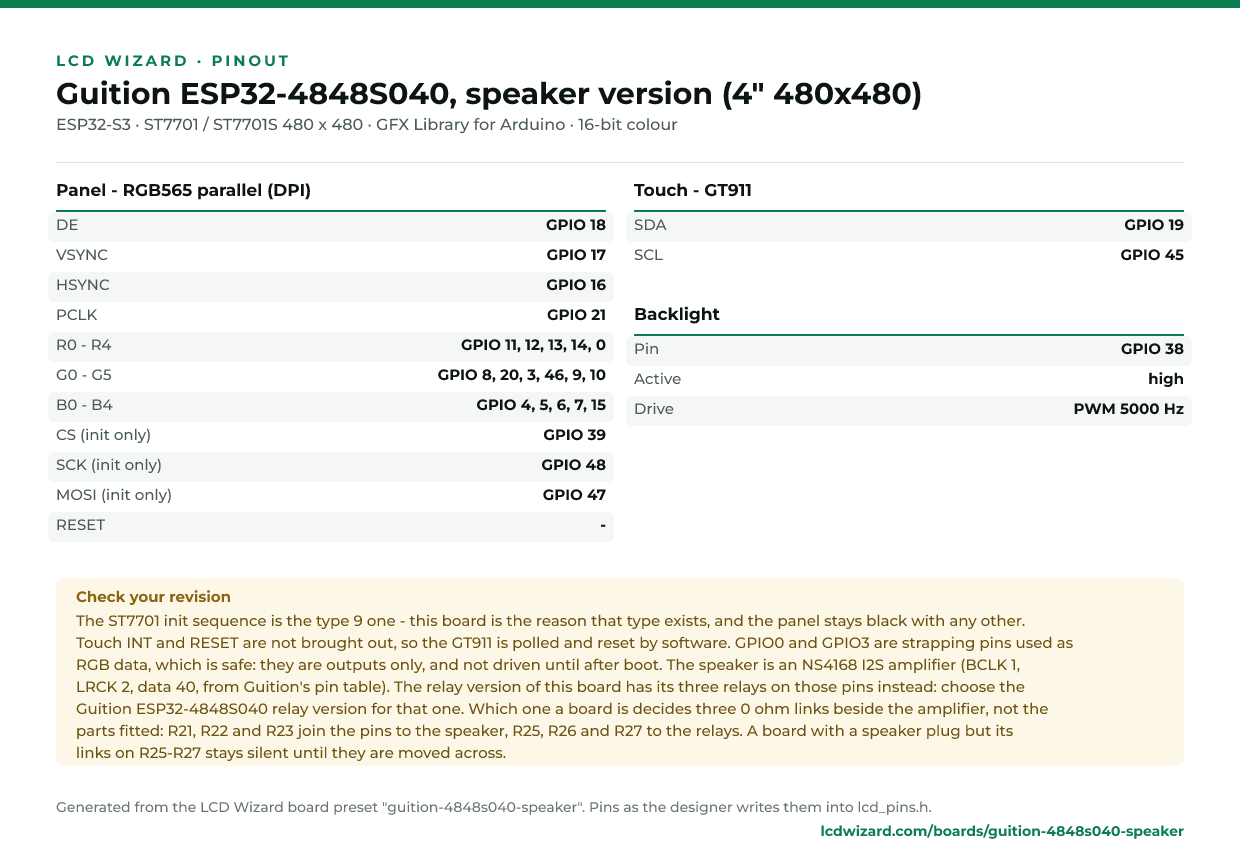
The pinout on one page
Every pin above, laid out to print and keep beside the bench. Generated from this preset, so it says exactly what the designer writes into lcd_pins.h.
Download the pinout (PNG)Open it as SVG
The same pins as data - board.json and pins.csv - are in the open pinout dataset on GitHub, free to reuse under CC BY 4.0.
From the people who made it
The board’s own documentation. Pinouts on vendor pages do sometimes disagree with the hardware in front of you - where this page and that one differ, trust your board and tell us.
- Vendor documentation
- ST7701 panel controller datasheet (Sitronix, via Crystalfontz)
- platformio-espressif32-sunton board definitions incl. esp32-4848S040CIY1/CIY3 (community)
Designs for this board
Nobody has published a design for this board yet. Publish yours from the designer and it appears here and in the gallery.
Similar boards
 Guition ESP32-4848S040, relay version (4" 480x480)4" 480x480 square ST7701 panel with GT911 touch and three relays, sold as the "86 box" wall-plate unit.ESP32-S3 · ST7701 / ST7701S 480 x 480 · GT911 touch
 ESP32-S3 + ST7701S 480x480 round480x480 RGB panel that needs a 3-wire SPI init sequence alongside the RGB bus.ESP32-S3 · ST7701 / ST7701S 480 x 480 · CST328 touch
 Waveshare ESP32-S3-Touch-LCD-2.8B2.8" 480x640 IPS panel (ST7701, RGB) with GT911 touch, a TF card slot, QMI8658 IMU, PCF85063 RTC and battery sense. A TCA9554 expander handles the panel's reset and chip select and the touch reset.ESP32-S3 · ST7701 / ST7701S 480 x 640 · GT911 touchPurchase this board
 Waveshare ESP32-S3-Touch-LCD-2.8C2.8" 480x480 round IPS panel (ST7701, RGB) with GT911 touch, a TF card slot, QMI8658 IMU, PCF85063 RTC, a buzzer and battery sense. A TCA9554 expander handles the panel's reset and chip select and the touch reset.ESP32-S3 · ST7701 / ST7701S 480 x 480 · GT911 touch
 VIEWE UEDX48480040E-WB-A (4" 480x480)4" 480x480 square GC9503V RGB panel with FT6336U touch, on an ESP32-S3 N16R8.ESP32-S3 · GC9503V 480 x 480 · FT6236 / FT6336U touch
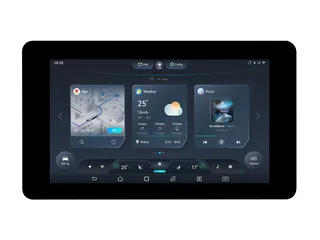 Waveshare ESP32-S3-Touch-LCD-77" 800x480 RGB panel with GT911 touch, a TF card slot, RS485, CAN and a sensor input. Same wiring as the 4.3" board, its own timings.ESP32-S3 · Generic RGB565 panel 800 x 480 · GT911 touchPurchase this board
Next
- Quick start - from an empty screen to firmware on the board
- Boards and displays - presets, controllers, pins and touch in the designer
- Flashing and configuration - PlatformIO, the Arduino IDE and first-boot checks
- Troubleshooting - a white screen, mirrored image or touch that misses