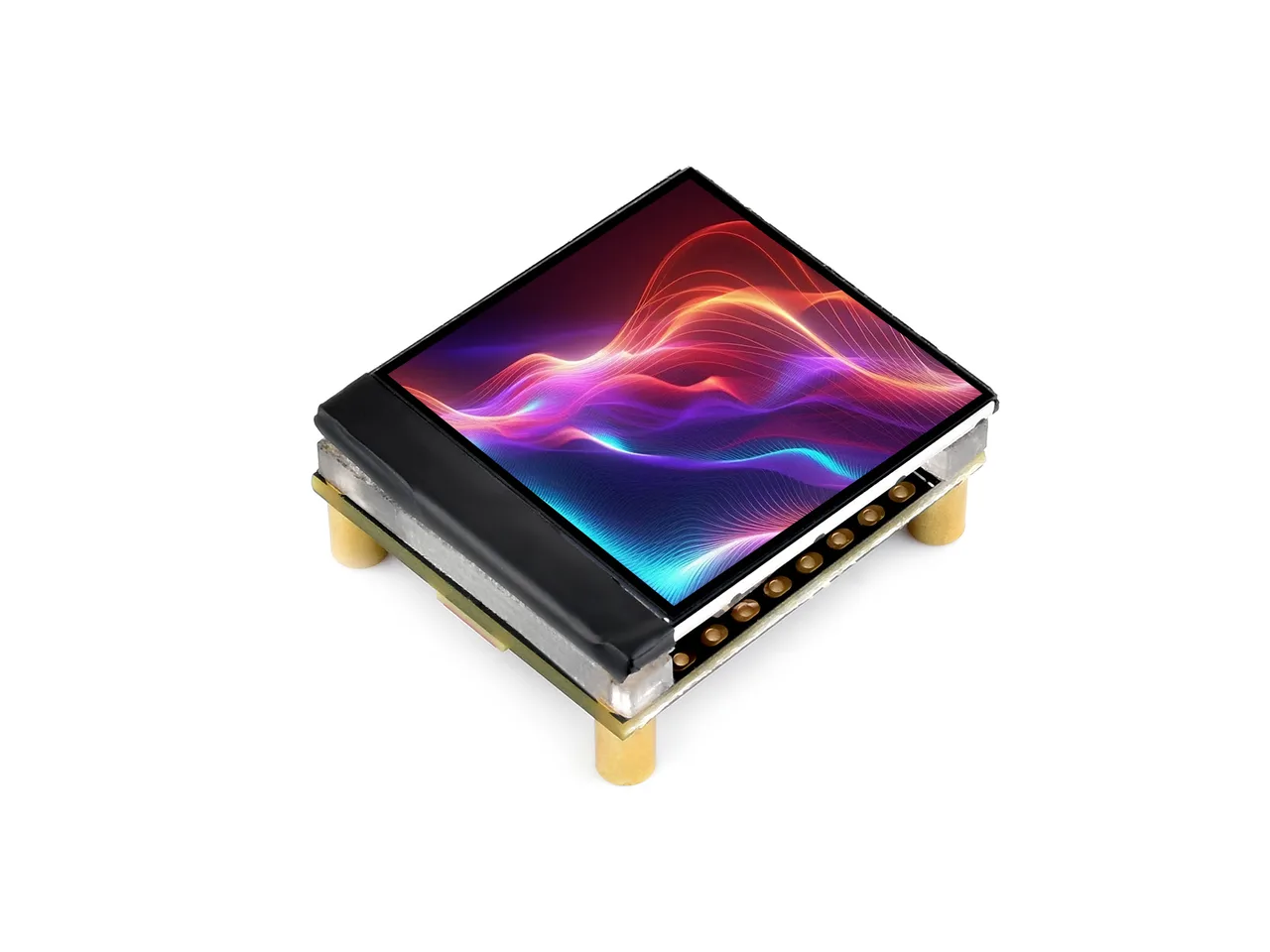
Waveshare ESP32-S3-LCD-1.3
1.3" 240x240 IPS LCD (ST7789VW, SPI), TF card, QMI8658.
Building for it
A project is made for one toolchain, picked when you start it. All three can drive this board:
| Toolchain | |
|---|---|
| Arduino (C++) | Every board, every widget and every peripheral here. The most control, and the most to set up. Start a project |
| MicroPython | Change a screen by editing a file on the board. No compiler once it is flashed. Start a project |
| ESPHome | No compiler to install, and the panel can join Home Assistant as real entities. Start a project |
At a glance
| Part | Detail |
|---|---|
| Maker | Waveshare |
| MCU | ESP32-S3 Xtensa LX7 dual-core @ 240 MHz, 512 KB SRAM (+ 2-16 MB PSRAM on most modules) |
| Display | Sitronix ST7789, 240 x 240 px, SPI (4-wire serial), 16-bit colour |
| Touch | None |
| Backlight | GPIO 20, dimmable (PWM) |
| Memory | 16 MB flash, 8 MB octal PSRAM (N16R8) |
| Graphics library | GFX Library for Arduino |
Display pins
ST7789 on SPI (4-wire serial): SPI clock 40 MHz, host SPI2_HOST, RGB colour order, inversion on.
| Signal | Pin |
|---|---|
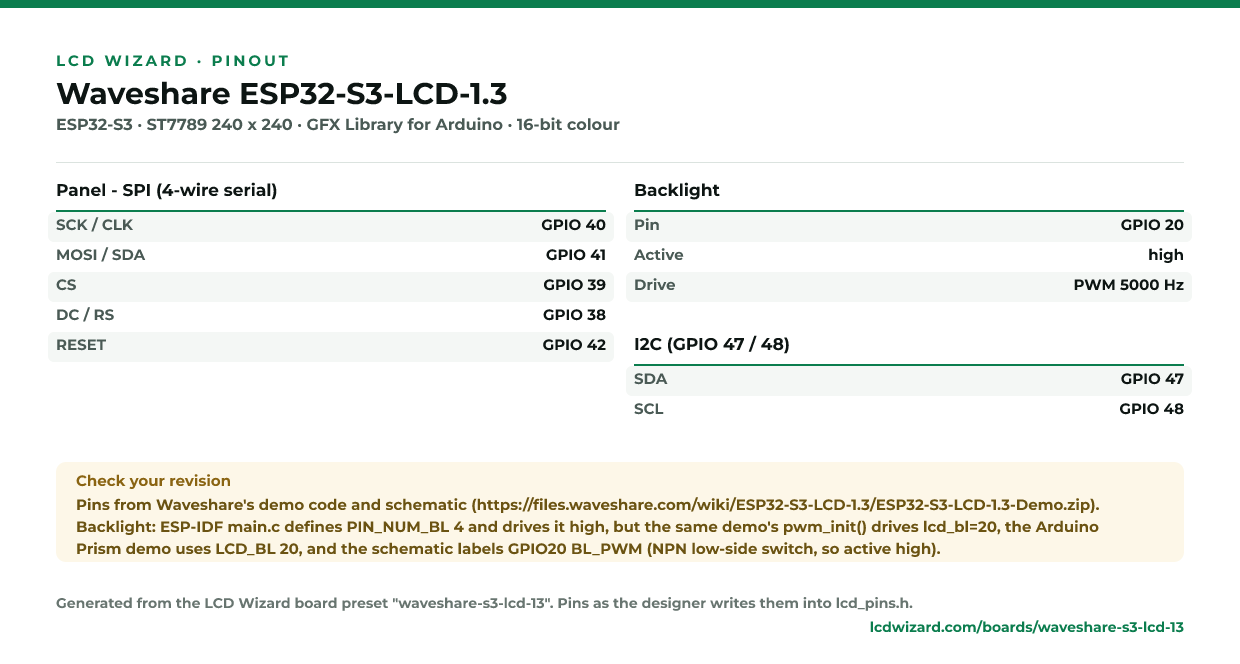
| SCK / CLK | GPIO 40 |
| MOSI / SDA | GPIO 41 |
| CS | GPIO 39 |
| DC / RS | GPIO 38 |
| RESET | GPIO 42 |
| Backlight | GPIO 20 |
Also on the board
- I2C (GPIO 47 / 48) - SDA GPIO 47, SCL GPIO 48
The preset adds these to the Hardware tab with the board, so a sensor can go straight onto the connector.
Check your revision. Pins from Waveshare's demo code and schematic (https://files.waveshare.com/wiki/ESP32-S3-LCD-1.3/ESP32-S3-LCD-1.3-Demo.zip). Backlight: ESP-IDF main.c defines PIN_NUM_BL 4 and drives it high, but the same demo's pwm_init() drives lcd_bl=20, the Arduino Prism demo uses LCD_BL 20, and the schematic labels GPIO20 BL_PWM (NPN low-side switch, so active high).
Designing for it in LCD Wizard
- Choose Waveshare ESP32-S3-LCD-1.3 on the Hardware tab (or use the button above) and every pin on this page is filled in. The export writes the sketch,
lcd_pins.h, the GFX Library for Arduino configuration,lv_conf.handplatformio.ini- a project that builds for this board as it comes. - The backlight is dimmable: give a slider or a button a Set backlight action.
- With PSRAM the LVGL memory pool can live there, leaving internal RAM for everything else.
- Screens are designed for 240 x 240 px in either orientation, with LVGL 9 or LVGL 8.
The parts
ST7789. Excellent colour and tolerates 80 MHz SPI. Many modules have no CS pin - tie it low and set CS to -1.
ESP32-S3. The only common Arduino target with a hardware RGB565 LCD peripheral. PSRAM is effectively required for RGB panels.
GFX Library for Arduino. Moshi Liu's library. Best QSPI/AMOLED and RGB coverage. Configured in code.
The pinout on one page
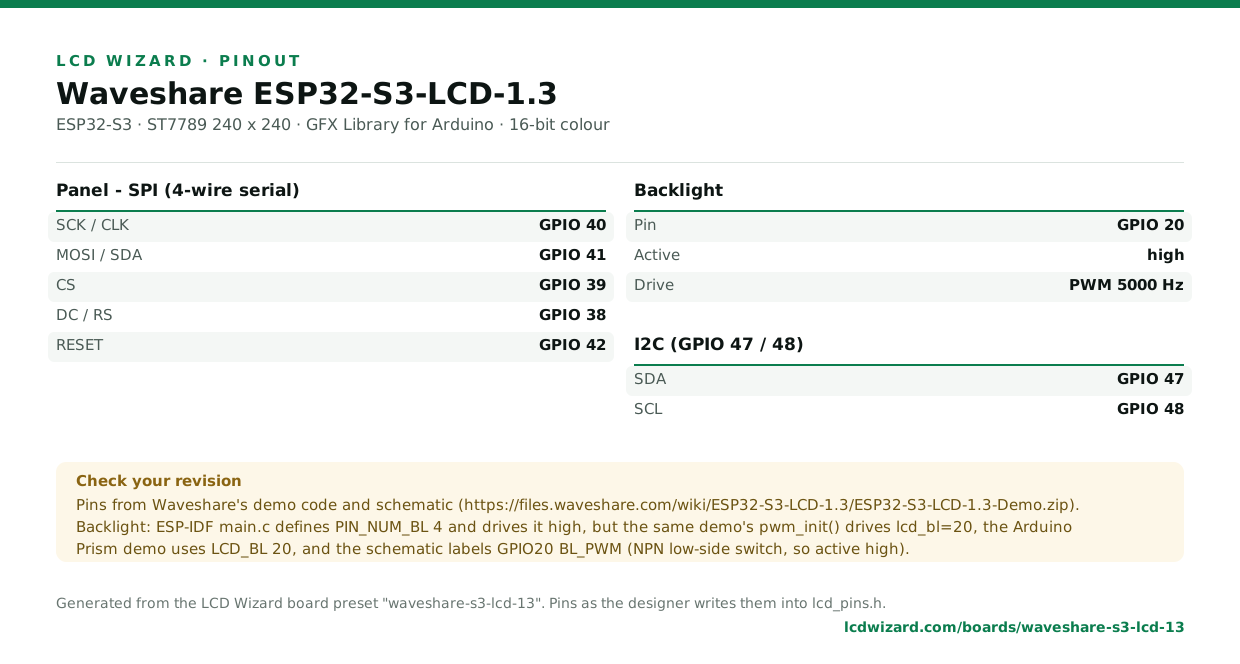
Every pin above, laid out to print and keep beside the bench. Generated from this preset, so it says exactly what the designer writes into lcd_pins.h.
Download the pinout (PNG)Open it as SVG
From the people who made it
The board’s own documentation. Pinouts on vendor pages do sometimes disagree with the hardware in front of you - where this page and that one differ, trust your board and tell us.
- The vendor’s product page
- Vendor documentation
- Schematic (PDF)
- Waveshare demo code (pins read from here)
Designs for this board
Nobody has published a design for this board yet. Publish yours from the designer and it appears here and in the gallery.
Similar boards
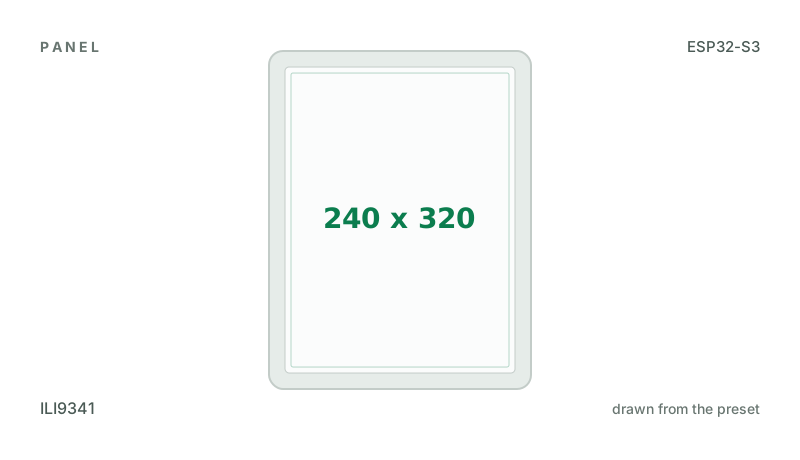 ESP32-S3 + ILI9341 SPIESP32-S3 DevKitC wired to a 2.8" ILI9341 with XPT2046 touch.ESP32-S3 · ILI9341 240 x 320 · XPT2046 touch
 ESP32-S3 + GC9A01 1.28" round240x240 round panel with CST816S single-touch. Popular for watch faces and gauges.ESP32-S3 · GC9A01 / GC9A01A 240 x 240 · CST816S touch
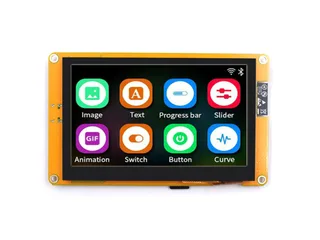 Sunton ESP32-8048S043 (4.3" RGB)4.3" 800x480 RGB565 panel with GT911 capacitive touch and 8 MB PSRAM.ESP32-S3 · ST7262 800 x 480 · GT911 touch
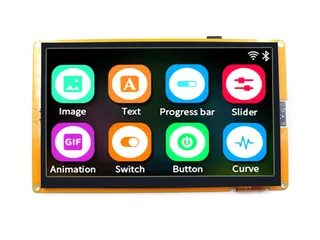 Sunton ESP32-8048S070 (7" RGB)7" 800x480 RGB565 panel with GT911 touch. Same family as the 4.3" board, different RGB pin order.ESP32-S3 · ST7262 800 x 480 · GT911 touch
Next
- Quick start - from an empty screen to firmware on the board
- Boards and displays - presets, controllers, pins and touch in the designer
- Flashing and configuration - PlatformIO, the Arduino IDE and first-boot checks
- Troubleshooting - a white screen, mirrored image or touch that misses