Waveshare ESP32-P4-WIFI6-Touch-LCD-10.1
10.1" 800x1280 MIPI-DSI panel (JD9365) with GT911 touch on an ESP32-P4, and Wi-Fi through its ESP32-C6. Compiled, not yet seen on a board.
Building for it
A project is made for one toolchain, picked when you start it. For this board you can use two of the four:
| Toolchain | |
|---|---|
| Arduino (C++) | Every board, every widget and every peripheral here. The most control, and the most to set up. Start a project |
| MicroPython | The MicroPython export has not been built for this chip yet. It is written for the ESP32, S2, S3, C3 and C6. |
| ESPHome | The ESP32-P4 is only useful here with a MIPI-DSI panel, which this export does not write yet. |
| ESP-IDF (C) | Espressif's own framework: esp_lcd, the component registry and idf.py, with nothing of Arduino in it. Start a project |
At a glance
| Part | Detail |
|---|---|
| Maker | Waveshare |
| MCU | ESP32-P4 RISC-V dual-core @ 400 MHz, 768 KB SRAM (+ PSRAM) |
| Display | Jadard JD9365, 800 x 1280 px, MIPI-DSI, 16-bit colour |
| Touch | Goodix GT911 (capacitive, I2C) |
| Backlight | GPIO 26, dimmable (PWM) |
| Memory | 32 MB flash, 32 MB PSRAM (N32R32) |
| Graphics library | GFX Library for Arduino |
Display pins
JD9365 on MIPI-DSI: RGB colour order, inversion off.
| Signal | Pin |
|---|---|
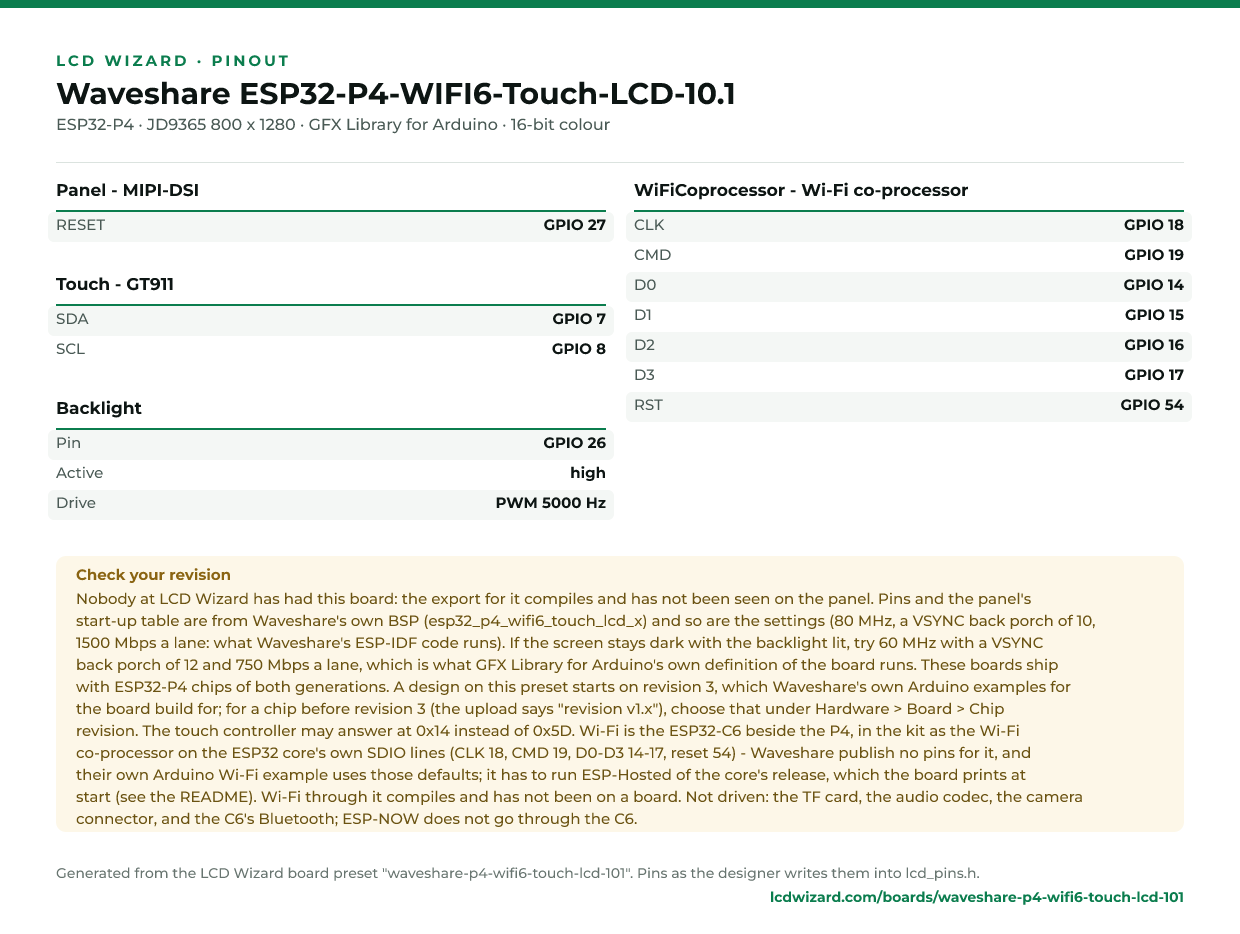
| RESET | GPIO 27 |
| Backlight | GPIO 26 |
Touch pins
GT911: I2C address 0x5D, 400 kHz.
| Signal | Pin |
|---|---|
| SDA | GPIO 7 |
| SCL | GPIO 8 |
| RESET | not connected |
Also on the board
- WiFiCoprocessor - Wi-Fi co-processor, CLK GPIO 18, CMD GPIO 19, D0 GPIO 14, D1 GPIO 15, D2 GPIO 16, D3 GPIO 17, RST GPIO 54
The ESP32-C6 beside the P4 is this board's Wi-Fi, on the ESP32 core's own SDIO lines for the P4, which Waveshare's own Arduino Wi-Fi example relies on. It must run ESP-Hosted of the core's release (the README says how to tell). Waveshare flash the C6 directly through its own UART pads, C6_IO9 held low and the P4 in download mode (their FAQ). Their ESP-IDF examples are written for ESP-Hosted 1.4, so a C6 as it leaves the factory may be of that older line and need updating.
The preset adds these to the Hardware tab with the board, so a sensor can go straight onto the connector.
Check your revision. Nobody at LCD Wizard has had this board: the export for it compiles and has not been seen on the panel. Pins and the panel's start-up table are from Waveshare's own BSP (esp32_p4_wifi6_touch_lcd_x) and so are the settings (80 MHz, a VSYNC back porch of 10, 1500 Mbps a lane: what Waveshare's ESP-IDF code runs). If the screen stays dark with the backlight lit, try 60 MHz with a VSYNC back porch of 12 and 750 Mbps a lane, which is what GFX Library for Arduino's own definition of the board runs. These boards ship with ESP32-P4 chips of both generations. A design on this preset starts on revision 3, which Waveshare's own Arduino examples for the board build for; for a chip before revision 3 (the upload says "revision v1.x"), choose that under Hardware > Board > Chip revision. The touch controller may answer at 0x14 instead of 0x5D. Wi-Fi is the ESP32-C6 beside the P4, in the kit as the Wi-Fi co-processor on the ESP32 core's own SDIO lines (CLK 18, CMD 19, D0-D3 14-17, reset 54) - Waveshare publish no pins for it, and their own Arduino Wi-Fi example uses those defaults; it has to run ESP-Hosted of the core's release, which the board prints at start (see the README). Wi-Fi through it compiles and has not been on a board. Not driven: the TF card, the audio codec, the camera connector, and the C6's Bluetooth; ESP-NOW does not go through the C6.
Designing for it in LCD Wizard
- Choose Waveshare ESP32-P4-WIFI6-Touch-LCD-10.1 on the Hardware tab (or use the button above) and every pin on this page is filled in. The export writes the sketch,
lcd_pins.h, the GFX Library for Arduino configuration,lv_conf.handplatformio.ini- a project that builds for this board as it comes. - The GT911 is capacitive and needs no calibration. The firmware resets it and checks it answers on every boot.
- The backlight is dimmable: give a slider or a button a Set backlight action.
- With PSRAM the LVGL memory pool can live there, leaving internal RAM for everything else.
- Screens are designed for 800 x 1280 px in either orientation, with LVGL 9 or LVGL 8.
The parts
JD9365. ESP32-P4 only, with PSRAM. 800x1280, portrait. Compiled, not yet seen on a board.
GT911. The address is selected by the INT pin level during reset, so wire INT and RST if you can.
ESP32-P4. Has a MIPI-DSI host and a 2D graphics accelerator (PPA). Arduino core support is newer - verify your core version.
GFX Library for Arduino. Moshi Liu's library. Best QSPI/AMOLED and RGB coverage. Configured in code.
The pinout on one page
Every pin above, laid out to print and keep beside the bench. Generated from this preset, so it says exactly what the designer writes into lcd_pins.h.
Download the pinout (PNG)Open it as SVG
The same pins as data - board.json and pins.csv - are in the open pinout dataset on GitHub, free to reuse under CC BY 4.0.
Designs for this board
Nobody has published a design for this board yet. Publish yours from the designer and it appears here and in the gallery.
Similar boards
 Waveshare ESP32-P4-NANO + 10.1-DSI-TOUCH-AWaveshare's 10.1" 800x1280 MIPI-DSI screen (JD9365) with GT911 touch on their ESP32-P4-NANO, whose backlight is a register on I2C. With the NANO's ES8311 codec, TF card, Ethernet and Wi-Fi through its ESP32-C6. Compiled, not yet seen on a bESP32-P4 · JD9365 800 x 1280 · GT911 touchPurchase this board
 Waveshare ESP32-P4-NANO + 8-DSI-TOUCH-AWaveshare's 8" 800x1280 MIPI-DSI screen (JD9365) with GT911 touch on their ESP32-P4-NANO, whose backlight is a register on I2C. With the NANO's ES8311 codec, TF card, Ethernet and Wi-Fi through its ESP32-C6. Compiled, not yet seen on a boarESP32-P4 · JD9365 800 x 1280 · GT911 touchPurchase this board
 Waveshare ESP32-P4-NANO + 7-DSI-TOUCH-AWaveshare's 7" 720x1280 MIPI-DSI screen (ILI9881C) with GT911 touch on their ESP32-P4-NANO, whose backlight is a register on I2C. With the NANO's ES8311 codec, TF card, Ethernet and Wi-Fi through its ESP32-C6. Compiled, not yet seen on a boESP32-P4 · ILI9881C 720 x 1280 · GT911 touchPurchase this board
 Waveshare ESP32-P4-WIFI6-Touch-LCD-4.34.3" 480x800 MIPI-DSI panel (ST7701) with GT911 touch on an ESP32-P4, an ES8311 speaker codec, a TF card, a camera connector and Wi-Fi through its ESP32-C6. Compiled, not yet seen on a board.ESP32-P4 · ST7701 (MIPI-DSI) 480 x 800 · GT911 touchPurchase this board
 Waveshare ESP32-P4-WIFI6-Touch-LCD-55" 720x1280 MIPI-DSI panel (HX8394) with GT911 touch on an ESP32-P4, an ES8311 speaker codec, a TF card and Wi-Fi through its ESP32-C6. Compiled, not yet seen on a board.ESP32-P4 · HX8394 720 x 1280 · GT911 touchPurchase this board
 Waveshare ESP32-P4-WIFI6-Touch-LCD-7B7" 1024x600 MIPI-DSI panel (EK79007) with GT911 touch on an ESP32-P4, an ES8311 speaker codec, a TF card, RS485, CAN and Wi-Fi through its ESP32-C6. Compiled, not yet seen on a board.ESP32-P4 · EK79007 1024 x 600 · GT911 touchPurchase this board
Next
- Quick start - from an empty screen to firmware on the board
- Boards and displays - presets, controllers, pins and touch in the designer
- Flashing and configuration - PlatformIO, the Arduino IDE and first-boot checks
- Troubleshooting - a white screen, mirrored image or touch that misses